
The Language of Margins: Understanding Markings and Notations
10/16/2025
The Hidden Language of Margins
Every fine print tells a story that extends beyond the image. The margins — often left blank by design — can contain markings that reveal how, when, and by whom a work was created or distributed. Understanding these subtle details allows collectors to read a print’s history like a manuscript.
Edition Numbers
The most common markings are edition numbers, typically written in pencil as a fraction, such as 15/75. The first number identifies the individual impression, and the second denotes the total number of prints in that edition. The numbering does not necessarily indicate the order of printing. Smaller edition sizes often correlate with higher rarity and value, though condition and provenance remain equally important.
Artist’s Signature and Date
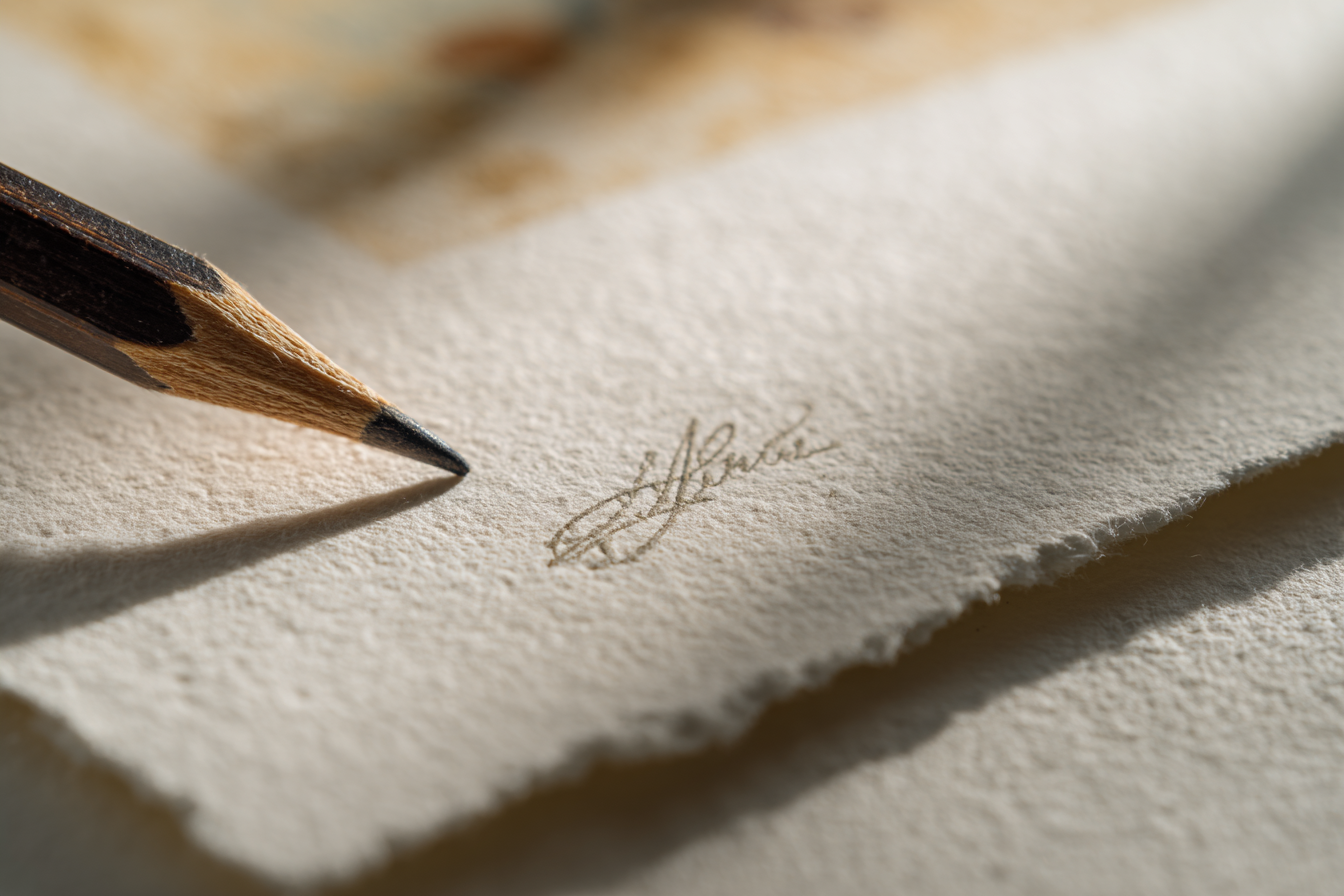
Most fine prints bear the artist’s signature and sometimes the year of printing, usually written in pencil just below the image. A pencil signature resists fading and signifies direct artist involvement. In some cases, signatures were added post-production under the artist’s supervision or estate authorization. When the artist was unable to sign, authorized estate stamps or publisher signatures may appear instead.
Publisher and Printer Stamps
Many prints include discreet embossed stamps or blind seals indicating the publisher or master printer. These marks typically authenticate the print’s production source and link it to a specific workshop or edition project. Renowned publishers — such as Mourlot in Paris or Petersburg Press in London — are closely associated with technical excellence and verified provenance.
Annotations and Proofs
Collectors may encounter notations such as A.P. (Artist’s Proof), E.A. (Épreuve d’Artiste), or T.P. (Trial Proof). These impressions are printed outside the standard edition, often for the artist’s personal use or for testing color and composition. Artist’s Proofs usually account for around 10–15% of the total edition and are identical in quality to the main run, sometimes even more desirable for their rarity.
Special Impressions and Color Variants
Occasionally, prints are labeled with Bon à tirer (the artist-approved proof for the printer) or H.C. (hors commerce, “not for sale”). Only one bon à tirer proof is typically made, serving as the reference for all subsequent impressions. Color trial proofs may include handwritten notes describing pigment adjustments or tonal variations — tangible evidence of the creative process.
Reading the Margins
The margins of a print are more than empty space — they are an archive of authorship and intent. For curators and collectors alike, recognizing these signs transforms the act of viewing into one of understanding: a dialogue between artist, printer, and history.
House of Gulin educates collectors to interpret markings and notations with accuracy and confidence, ensuring that every acquisition is valued not only for its imagery but also for the craftsmanship and authenticity preserved within its margins.